

 |


TechnoFILE is copyright and a registered trademark © ® of
Pandemonium Productions.
All rights reserved.
E-mail us Here!
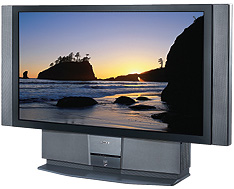
A Sanity Outbreak in HDTV Market? By Jim Bray It looks as if the “Great DVI Controversy” is being settled, and consumers should be the ultimate winner. If you hadn’t heard, there was talk that, due to Hollywood’s fear that digital television would open a floodgate of illegal, perfect copies, the industry was going to inflict DVI (Digital Video Interface) onto the marketplace which, according to the stories, would have been the only way to get true high definition signals. This would have meant that the people who'd already bought “HD-ready” televisions would be out of luck, that rather than being able to view true 1080i and/or 720p programming, the signal would be “dumbed down” to 480p. Now 480p is still pretty good, as anyone who’s watched a DVD played through a progressive scan player knows, but it pales in comparison with real HDTV. And this would have been a real slap in the face to those millions of consumers who already voted for HD with their wallets, buying their expensive televisions in good faith. A fine way to say “thank you” to the visionary consumers who kept the format going in its infancy, isn’t it? Fortunately, it appears this won’t happen after all. Last December, consumer electronics manufacturers made an agreement with US cable companies that will prevent such “down resing” (downconverting the signal), whether the high definition television uses DVI, 1394 “Firewire” or just plain old analogue component video. The agreement still requires the blessing of the US Federal Communications Commission (FCC), which has released the agreement for public comment in preparation for ruling on the deal. Does that mean the move to DVI and/or Firewire-equipped TV’s is over? Well, no. Some viewers and manufacturers, according to Consumer Electronics Association spokesman Jeffrey Joseph, believe DVI’s fatter pipeline gives the best possible picture because there’s no compression, but he also says the average consumer shouldn’t see any difference between an HD picture watched via DVI, Firewire or component video. This is good. The current agreement applies to digital TV receivers and any other consumer electronic device attached to a US cable system, not to satellite or “off air” signals, but t he CEA believes such an agreement could also apply to satellite and, someday, Internet broadcasts. There are currently no protections for off air signals, either, but the FCC is considering a proposal that would provide such protection. Meanwhile, HDTV, is spreading like wildfire in the US, and Canada has finally licenced its first digital HD channel: CITY-TV in Toronto, which began 1080i broadcasts in January, 2003. And some Canadian cable companies have also begun offering HD programming to compete with the Canadian satellite services, who’ve been transmitting HDTV for a couple of years. While HD programming is still relatively scarce in Canada, though this is changing thanks to new channels announced in March 2003 by Bell ExpressVu, it’s growing by leaps and bounds below the 49 th parallel, so it’s probably just a matter of time before Canada catches up. ESPN is scheduled to start HD broadcasts this year, which (if Sheila Copps and her band of protectionists would let Canadians receive it) would bring some great HD sporting events to display in Canadian homes as well as American. CBS (1080i) and ABC (720p) now show most of their prime time content in HD, though NBC is lagging behind. Fox also does quite a bit of 480p broadcasting (with some 720p) and WB and UPN are unleashing broadcasts in 1080i. There appears to be a real hunger for HD. North American sales of HD compatible televisions far exceed projections in 2002, with some 2.6 million sets moved from store shelves. The bottom line for consumers who’ve already bought HD-ready televisions is that you probably won’t get screwed by DVI after all, and that’s good news. This milestone deal between electronics manufacturers and US cable companies also paves the way for TV’s equipped with both digital and analogue tuners. This helps ensure that cable subscribers will be able to plug their HD TV into the cable without a set top box. At least for now, however, it may make sense for consumers to take a modular approach to HD, because there are new gadgets coming along (for instance HD PVR’s), that make easily changeable set top boxes a good idea. Oh! Don’t forget to ensure that if you're buying an HD-ready television that it displays 1080i, 720p and 480p signals without conversion. 1080i seems the most popular standard for broadcasters, but you might as well be able to receive everything offered. Jim Bray's technology columns are distributed by The TechnoFILE Syndicate . Copyright Jim Bray.
|
|
|

| Support TechnoFile via Paypal |
| TechnoFILE's
E-letter We're pleased to offer our FREE private, subscription-based private E-mail service. It's the "no brainer" way to keep informed. Our Privacy Policy |